

Shutters are a permanent addition to your home. They’re fixed into your window frames. They become part of the room’s architecture. And they stay there for over a decade or more.
That’s why the company behind the work matters so much. The survey, the manufacturing, the installation: these are the stages that determine how your shutters look, feel, and perform long after the fitter has packed up and left. Getting this decision right means understanding what to look for and what questions to ask.
At Shutters Sale, shutters are the only thing we do. We want to share what we’ve learned through years of surveying, fitting, and problem-solving across Surrey and South-West London, so that you can approach this decision with clarity.
Why a Shutter Specialist Makes a Real Difference
Interior shutters are not curtains or blinds. You can’t take them down, swap them out, and try again if something doesn’t work. They are engineered, built to measurement, and permanently mounted. The margin for error is small.
This is our entire craft. We don’t split our attention across curtains, blinds, awnings, and a dozen other products. Every survey we carry out, every measurement we take, every installation we complete is focused on shutters. That focus has given us a depth of understanding that comes from repetition, refinement, and learning from hundreds of installations across this region.
We know how different shutter materials behave in different rooms. We know which panel configurations work on specific window types and which ones create problems down the line. We’ve developed solutions for unusual frames, tight recesses, and the kind of imperfect walls that older properties in this part of the country present on a regular basis.
That accumulated knowledge shapes every recommendation we make. And it means we spot potential issues during the survey stage, long before they become visible problems on fitting day.
We Know the Properties in This Region
Surrey and South-West London have a housing stock that spans centuries. And we’ve worked across a significant portion of it.
The Victorian terraces of Putney, Wandsworth, and Battersea bring tall sash windows, curved bays, and timber frames that have shifted and settled over generations. A window that appears straight is often several millimetres out of square. Our survey process accounts for this every single time, because we’ve seen what happens when it doesn’t.
The Edwardian semis of Kingston, Surbiton, and Epsom tend to feature wide casement windows with generous proportions and deep reveals. These homes lend themselves beautifully to shutters when the style and mounting approach are chosen with care. The Georgian properties across Richmond, Barnes, and parts of Guildford introduce their own proportions: tall, narrow windows with fine period detailing that demands a sympathetic approach.
The shutter design needs to complement the architecture rather than compete with it. And across the region, newer apartments and family homes bring patio doors, bi-folds, and large expanses of glazing that require reinforced hardware and precise engineering.
We’ve fitted shutters in all of these settings. That breadth of experience means we’re rarely encountering a window type for the first time. And when we do come across something unusual, we have the knowledge and the problem-solving instinct to get it right.

Matching the Right Shutter to the Right Window
We install six core shutter styles. Each one exists for a reason, and recommending the right one is something we take seriously.
Full-height shutters
span the entire window, top to bottom. They create a clean, unbroken line and give you full control over light and privacy. For rooms where a simple, elegant look is the priority, they’re hard to beat.
Full-height shutters with a mid-rail
add a horizontal division at the midpoint of the panel. This lets you adjust the top and bottom louvres independently. In bedrooms and living rooms, that flexibility makes a noticeable difference to how you manage light throughout the day.
Tier-on-tier shutters
go further still. The upper and lower sections open and close as completely separate units. You can fold the top tier back entirely while keeping the lower section closed. For the tall sash windows found in period homes across Richmond, Wimbledon, and Clapham, this style works in harmony with the window’s own proportions.
Café-style shutters
cover the lower half of the window and leave the top half open. On ground-floor rooms along busy residential streets in Balham, Battersea, and Wandsworth, they solve the privacy problem without sacrificing natural light from above. They have a relaxed, continental look that suits the character of these neighbourhoods.
Bay window shutters
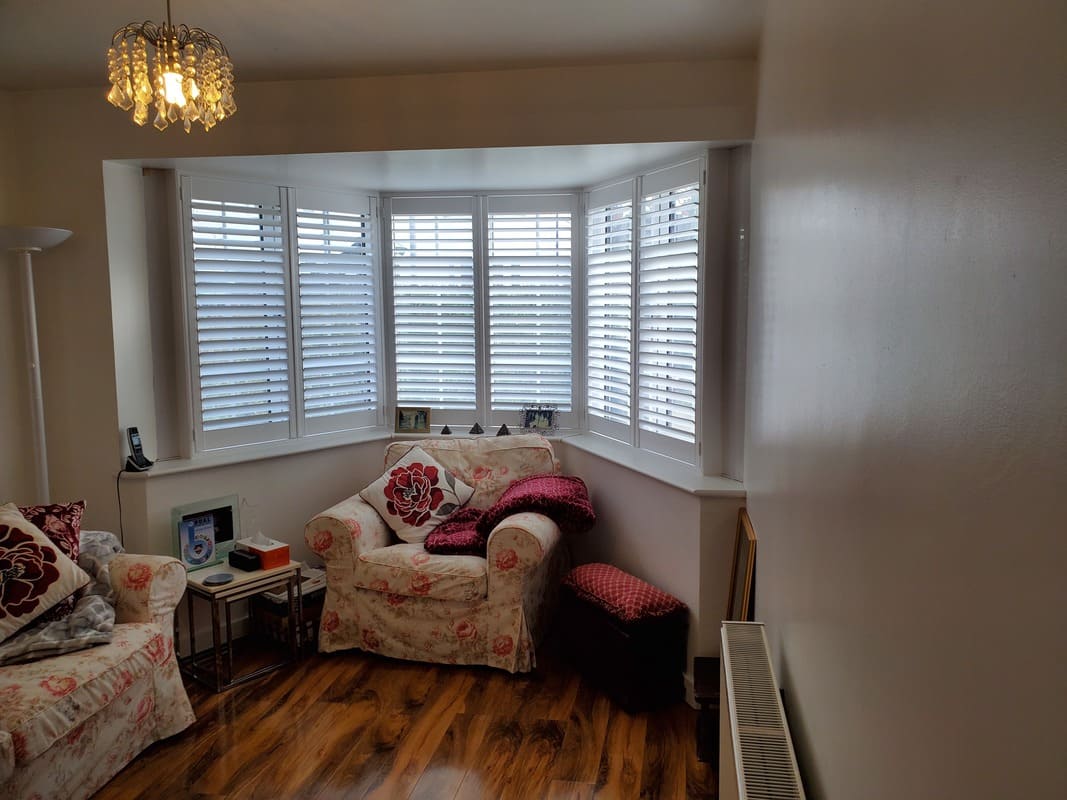
are among the most rewarding installations we carry out, and among the most demanding. The angled joins between panels must be precise. The configuration has to follow the geometry of the bay so that every panel opens and closes without interfering with its neighbour. We’ve fitted bays in homes across Epsom, Surbiton, Kingston, and throughout Wandsworth and Putney. When the engineering is right, a shuttered bay becomes the centrepiece of the room.
French and patio door shutters
carry more weight and absorb more daily movement than any other style we fit. Reinforced hinges, handle cutouts, and frames built for repeated use are essential. We engineer these to the specific door dimensions and usage pattern, because a shutter mounted on a door that opens twice a day faces very different stresses than one fixed to a static window frame.
We never recommend a style based on what’s popular. We recommend what suits your windows, your rooms, and the way you live in your home.
Materials We Trust and Why
We work with three core shutter materials. Each one serves a specific purpose, and we’re straightforward about the strengths and trade-offs of each.
Hardwood shutters made from basswood or paulownia are our standard recommendation for most rooms. They’re lightweight, stable, hold painted finishes beautifully, and age well. Over 20 years of daily use, a quality hardwood shutter retains its feel and appearance in a way that lesser materials cannot match.
Engineered composite shutters offer a more accessible price point. They perform well in dry, stable environments and can be a sensible choice for certain budgets. We present them honestly on those terms. They’re heavier than hardwood, less forgiving of moisture, and more susceptible to edge wear over time. For the right application, they do the job. We’ll tell you when they’re appropriate and when they’re not.
ABS waterproof shutters are what we recommend for bathrooms and wet rooms. They’re engineered to handle steam, splashing, and sustained humidity without warping, swelling, or discolouring. In rooms where moisture is constant, they’re the correct choice. We won’t recommend hardwood in a bathroom, because we’ve seen what happens when the wrong material meets the wrong environment.
When we sit down with you during the survey, we explain these options in plain terms. No jargon, no pressure toward a higher price point. The goal is to match the material to the room.
Our Process: Survey to Installation
We’ve refined this process over years of fitting, and every step exists for a reason.
The home survey is where everything starts. We measure every window individually, checking for squareness, recess depth, and frame condition. In older properties, we pay close attention to settlement and the small irregularities that are invisible to the eye but critical to a clean fit.
We discuss each room with you: how you use it, what matters to you, what you’re hoping to achieve. And we recommend a shutter style and material based on all of that information together. This survey is free, and it comes with no obligation. Prefer to book, call or fill in this form.
Manufacturing happens to your exact measurements. Every shutter is made to order. There is no adaptation of off-the-shelf panels, no trimming on site to force a fit. What arrives at your home on fitting day has been built specifically for each of your windows.
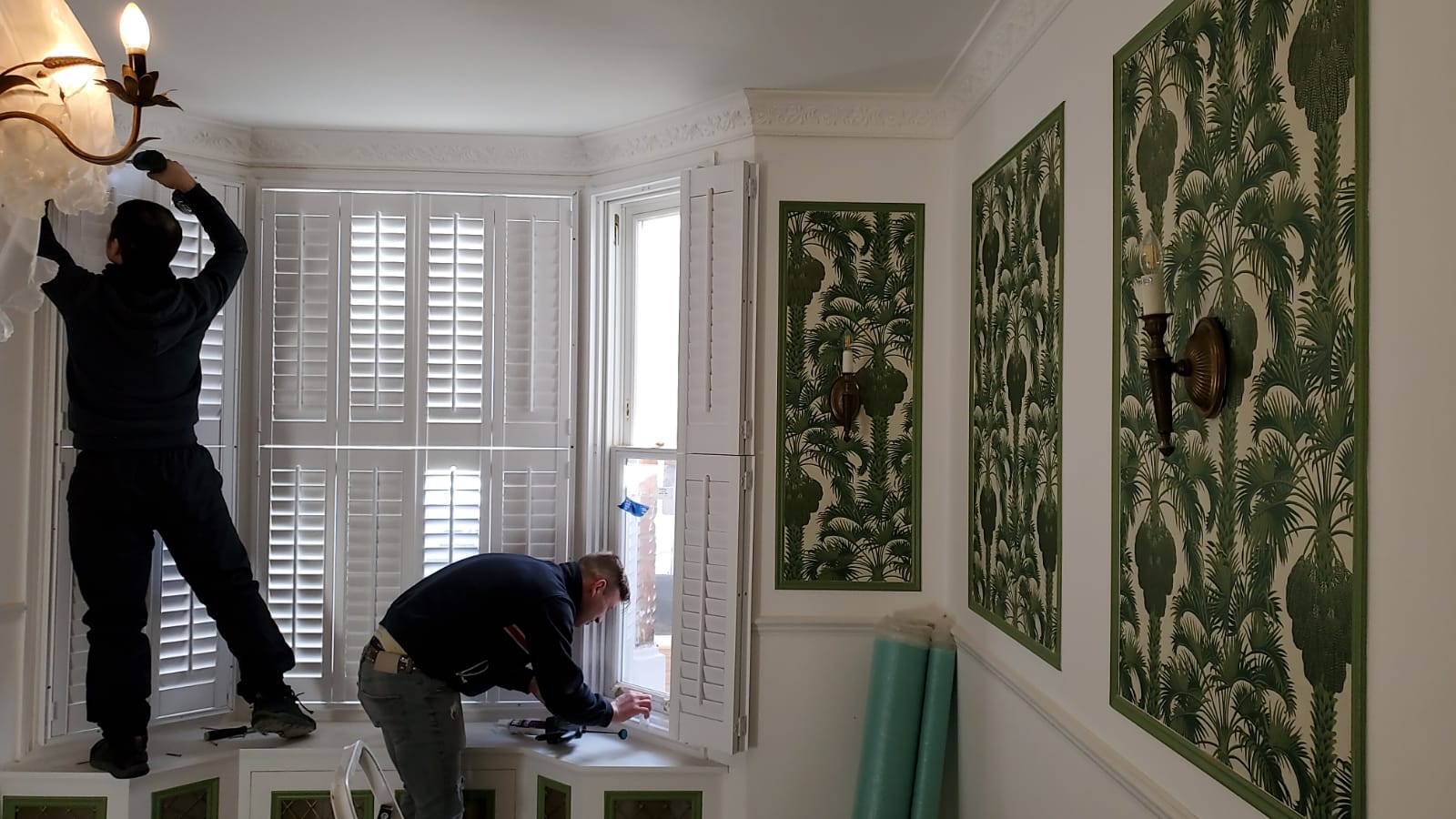
Installation is carried out by our own expert shutter fitters. The same team that understands your survey notes, your measurements, and every decision made along the way. Frames are checked for level after fixing. Panels are hung and tested for smooth operation. Louvres are adjusted so they tilt evenly across every panel. The finished result shows no visible fixings, filler, or rough edges.
We don’t subcontract this work. The people who fit your shutters are the people who know your project inside out.
A Clear, Honest Quote
After the survey, we provide a detailed written quote that breaks down what you’re getting: the shutter style, material, frame type, colour, and the guarantee terms. Everything is specified. Nothing is vague.
We believe you should know exactly what you’re paying for and why. That transparency makes the decision easier and builds the kind of trust that matters when someone is making a lasting change to their home.

This Is What We Do
We’ve fitted shutters across Surrey and South-West London for homeowners who care about getting this right. People who want their windows to look beautiful, their rooms to feel considered, and their investment to hold up over time.
If that sounds like what you’re looking for, we’d genuinely enjoy hearing from you. Get in touch with us to arrange a free home survey. We’ll visit at a time that works for you, talk through everything in person, and give you a clear recommendation along with a detailed quote.